SysAid
Languages:
Deutsch
English
Español
Français
Portuguese
Localization:
World

What is SysAid and how does it work?
Overview Description
SysAid is an AI-first IT Service Management (ITSM) platform built to help organizations manage internal services with less manual effort and higher operational clarity. It centralizes incident management, service requests, asset tracking, and workflow automation into a single system designed for modern IT teams. Instead of acting as a passive ticketing tool, SysAid actively assists teams through AI-powered classification, routing, and resolution support.
The platform is designed to support ITIL-aligned processes while remaining flexible enough for fast-moving teams that don’t want heavy bureaucracy. SysAid can be deployed in the cloud or on-premises, making it suitable for organizations with different security and compliance requirements. Its focus on automation and self-service reduces repetitive work for IT staff while improving response times and user satisfaction. The result is a service management environment that scales with organizational complexity without becoming operationally heavy.
How does SysAid handle IT service requests efficiently?
Key Features
-
AI-Powered Ticket Management
Automatically categorizes, prioritizes, and routes tickets based on content, urgency, and historical patterns, reducing manual triage. -
Self-Service Portal and Knowledge Base
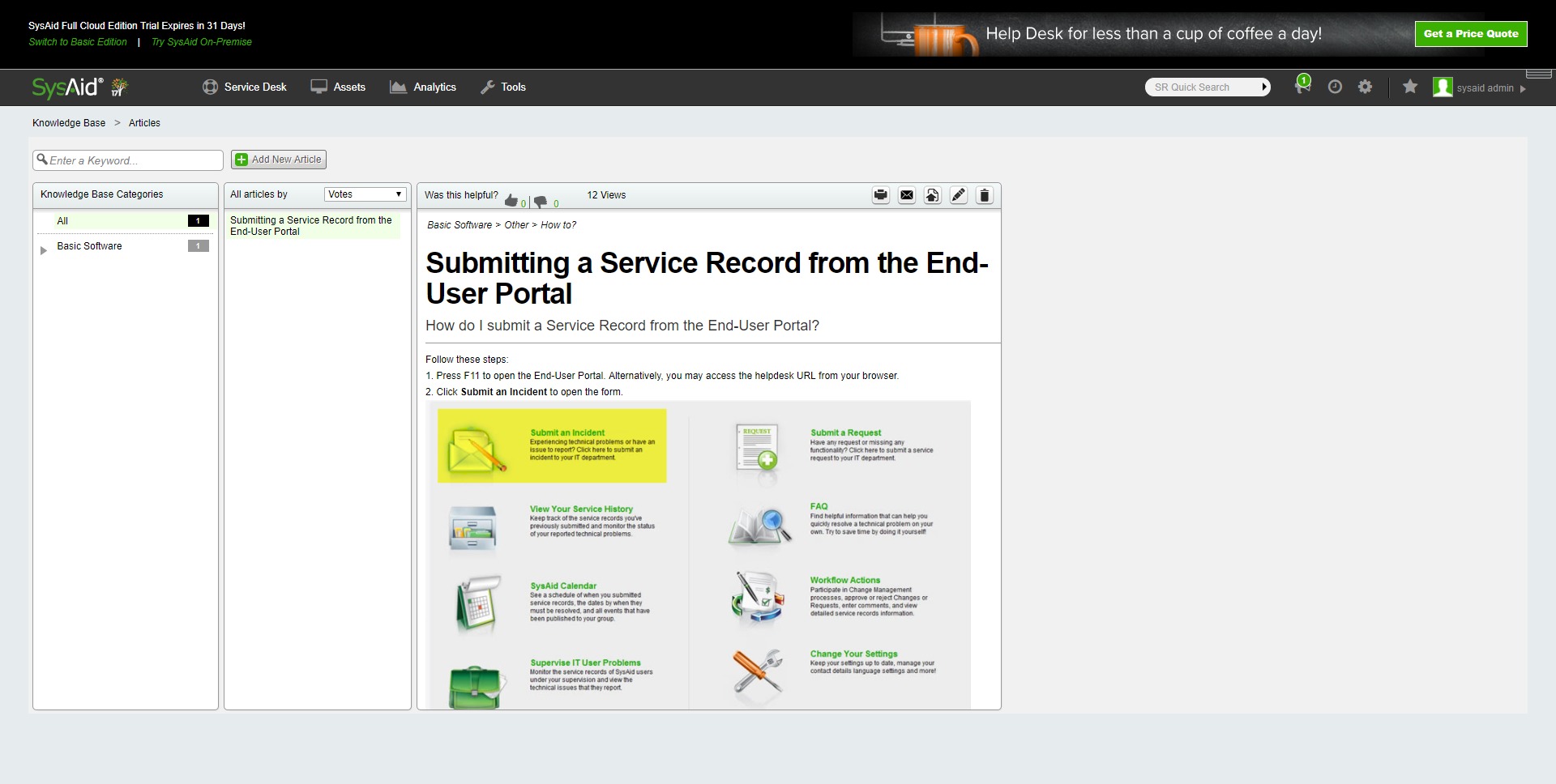
Provides employees with a centralized place to submit requests, track progress, and resolve common issues without contacting support. -
Asset and Configuration Management
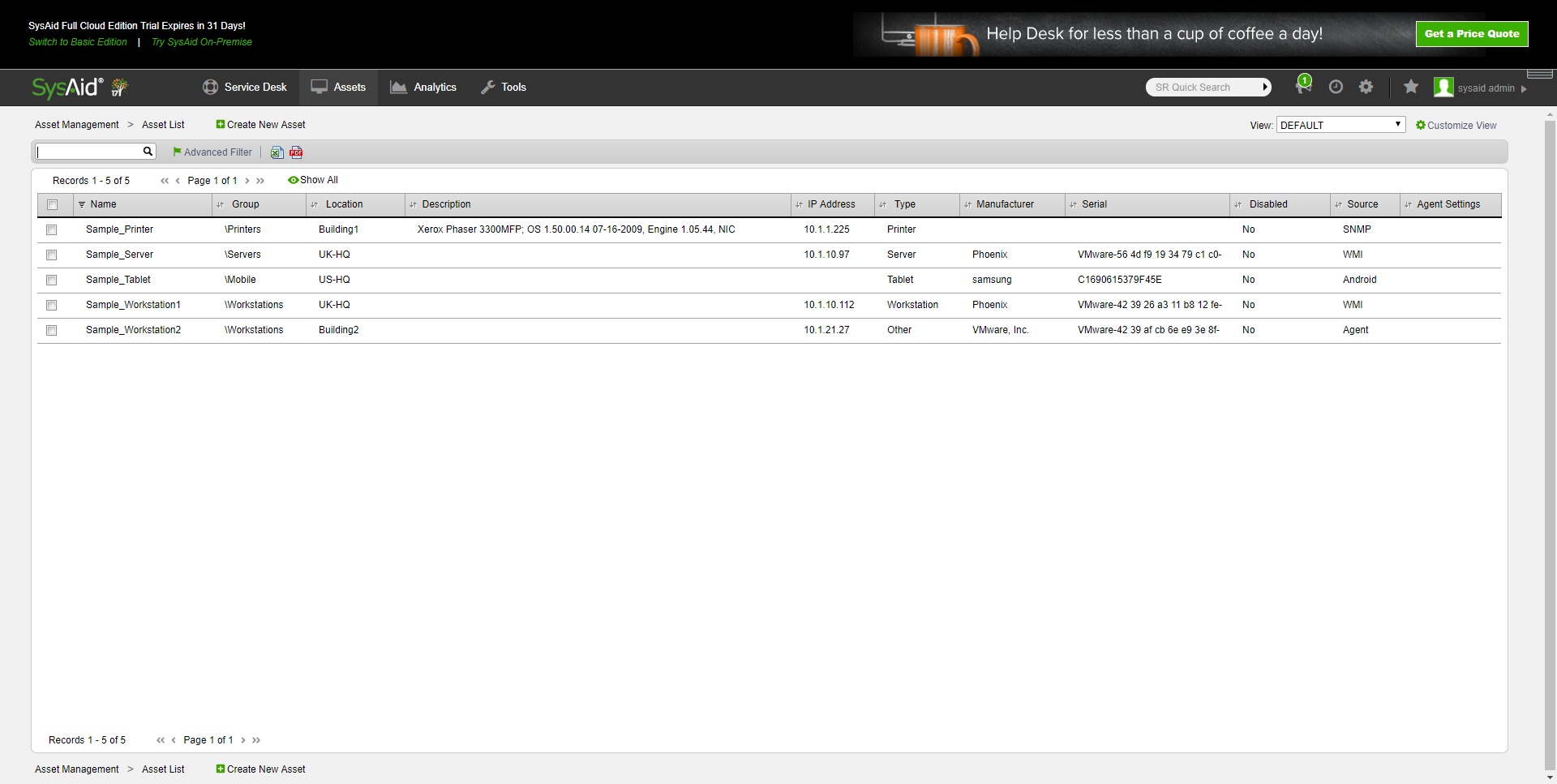
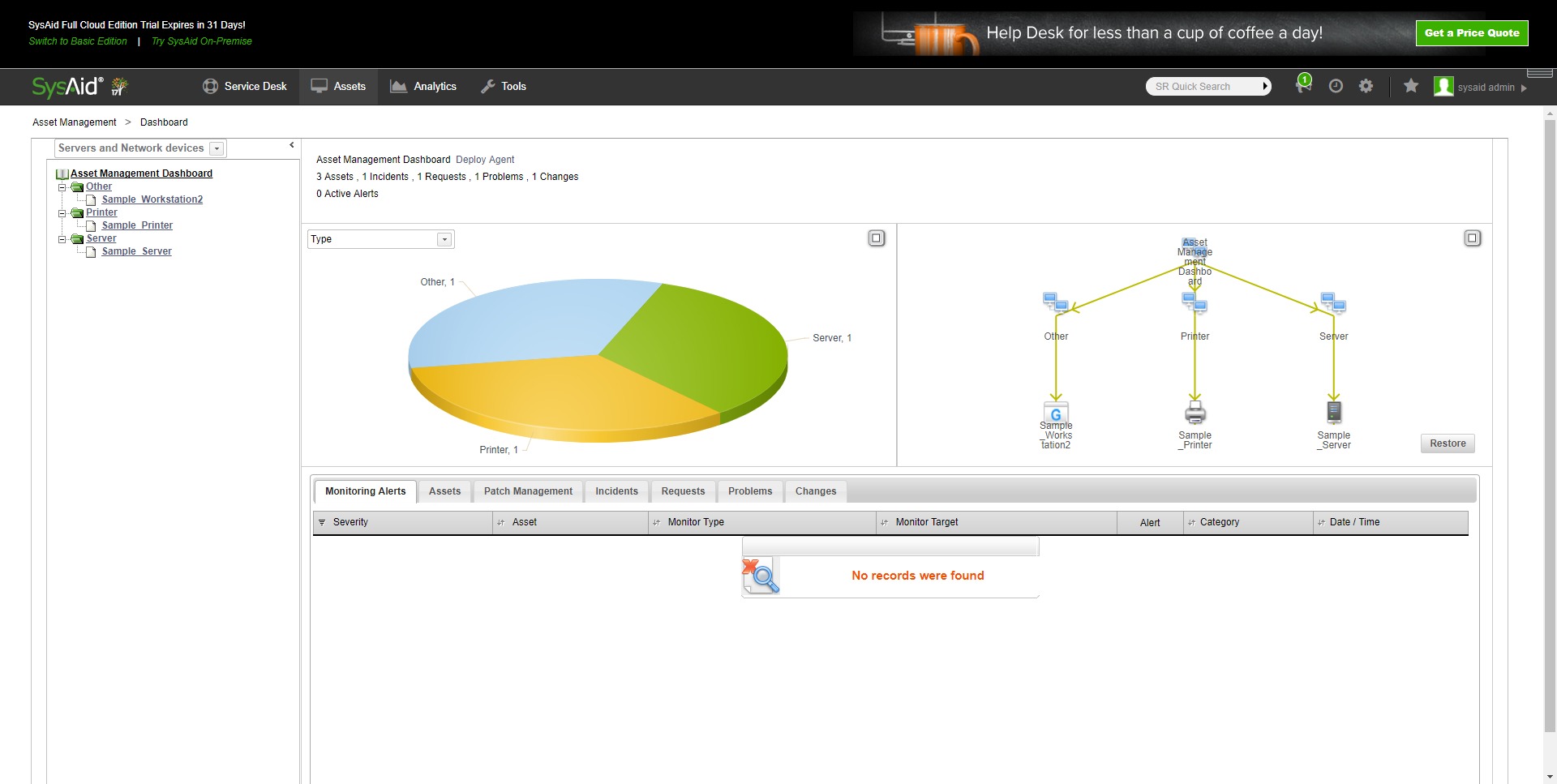
Maintains a live inventory of hardware, software, licenses, and configurations to support faster troubleshooting and informed decision-making. -
Workflow and Process Automation
Automates approvals, escalations, notifications, and cross-team handoffs using configurable rules and triggers. -
Change and Problem Management
Helps teams manage planned changes and recurring issues with visibility, risk control, and audit-ready documentation. -
Reporting and Performance Analytics
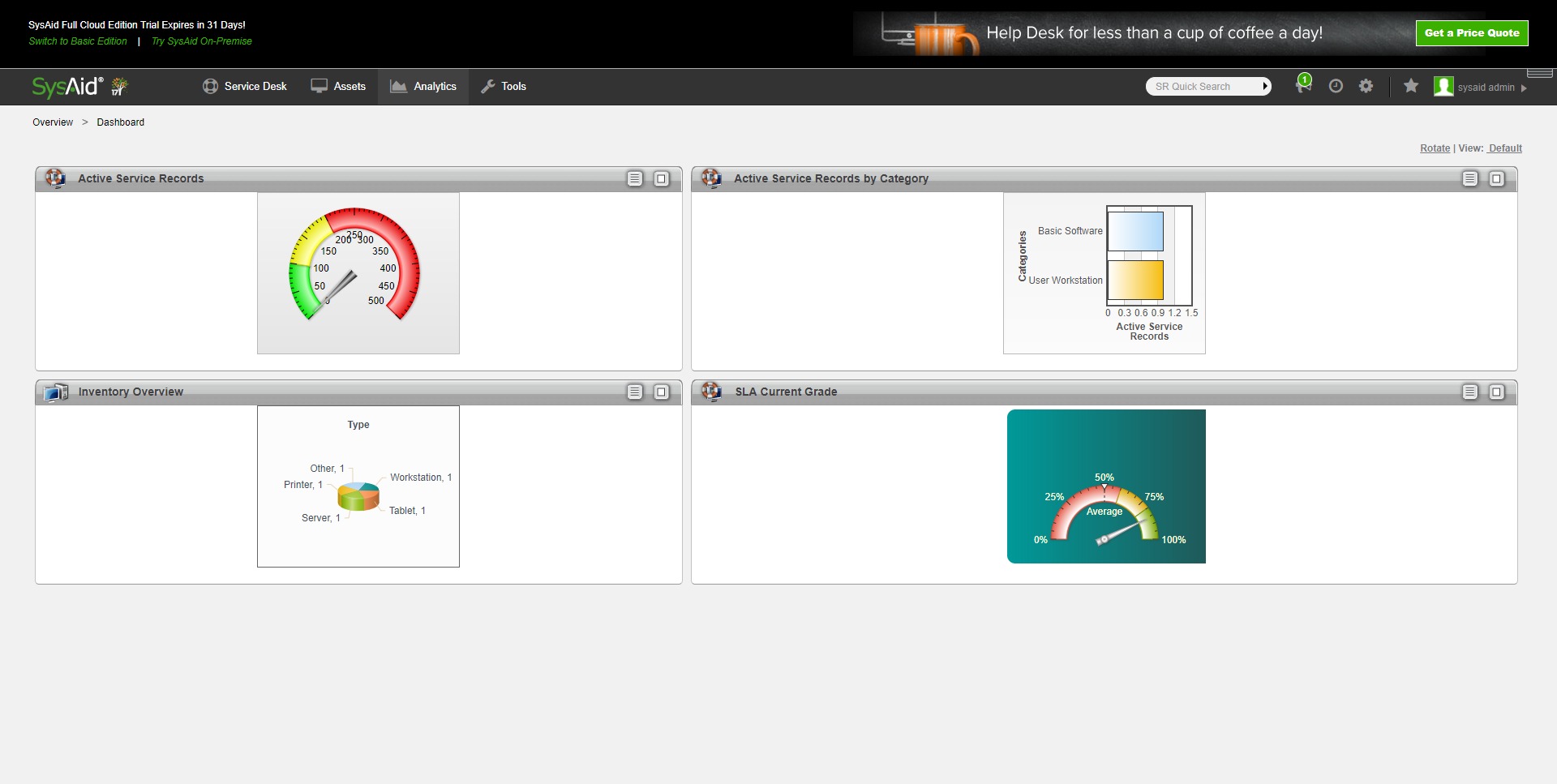
Delivers dashboards and reports for SLA tracking, workload analysis, bottleneck identification, and service optimization. -
Integration and Extensibility
Connects with identity systems, email platforms, monitoring tools, and business applications to fit into existing IT ecosystems.
Where is SysAid used in real organizations?
Use Case Highlights
-
Internal IT Help Desk Operations
Centralizes employee support requests and incidents, enabling faster resolution and consistent service delivery. -
Mid-Size and Enterprise IT Teams
Supports structured ITSM processes without requiring heavy customization or long implementation cycles. -
Remote and Hybrid Work Environments
Provides a single service access point for distributed teams, improving visibility and response times. -
Compliance-Focused Organizations
Helps maintain control over assets, changes, and service records for audits and internal governance. -
Service Desk Modernization Projects
Replaces legacy ticketing tools with AI-assisted automation and self-service capabilities.
Why do teams choose SysAid over traditional help desk tools?
Benefits
SysAid reduces operational friction by shifting IT teams away from manual coordination toward automated, intelligence-driven workflows. AI assistance lowers the time spent on repetitive tasks such as ticket classification and response drafting. Self-service capabilities decrease ticket volume while empowering end users to solve routine problems independently.
The platform improves transparency through centralized data on assets, services, and performance metrics. This visibility enables better planning, faster root-cause analysis, and more predictable service delivery. By supporting both structured ITIL practices and flexible automation, SysAid adapts to different maturity levels without forcing process overengineering. Over time, organizations benefit from lower support costs, improved service quality, and more strategic use of IT resources.
What is the user experience like for IT teams and employees?
User Experience
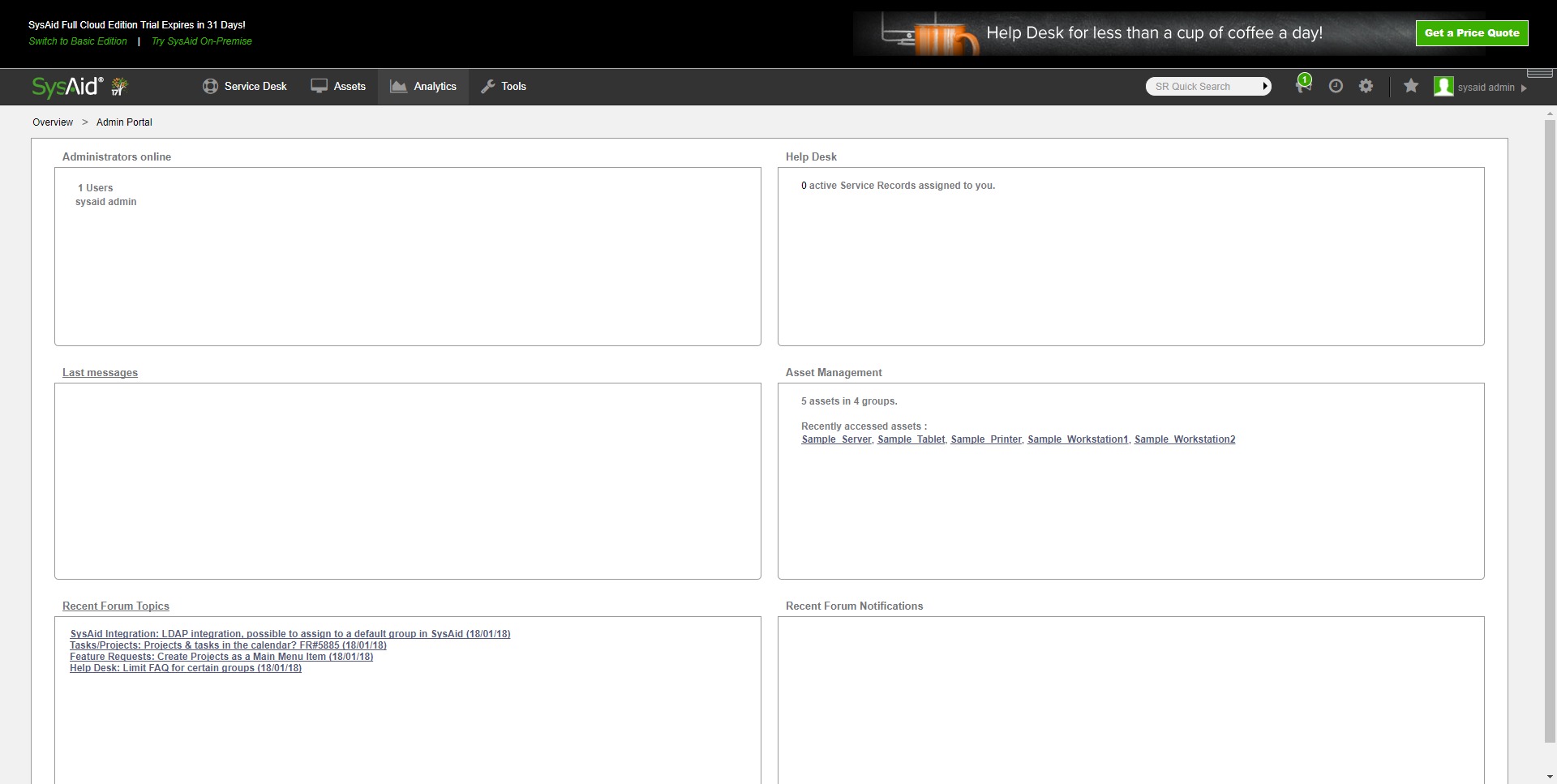
SysAid is designed to be approachable for both technical staff and non-technical users. IT agents work with configurable dashboards that surface priorities, deadlines, and contextual insights. Automation reduces noise, allowing teams to focus on meaningful work instead of administrative overhead.
For employees, the experience is straightforward: a clear portal for requests, transparent status updates, and quick access to helpful knowledge articles. AI-driven assistance and automation reduce wait times and frustration. Overall, SysAid delivers a balanced experience that prioritizes efficiency, clarity, and usability while supporting the growing complexity of modern IT operations.
2026-09-29 08:11:14: How a 2-Person IT Team Supports 200+ Users with AI Agents | Scotia Investments Youtube
2026-08-11 14:16:59: From 2 weeks to 8 hours: How Grand Traverse County cuts chargeback processing with SysAid AI Youtube
2026-08-10 13:35:26: Empoderando a los líderes de TI con SysAid AI: Automatización de ITSM de nueva generación Youtube
2026-08-05 08:58:46: MR. IT Ep. 4 | Building Autonomous IT: The Blueprint Youtube
2026-07-22 09:10:30: From 2 weeks to 8 hours: How Grand Traverse County cuts chargeback processing with SysAid AI Youtube
2026-07-22 09:01:36: How Scotia Investments provides superior service and faster ticket resolution with SysAid. Youtube
2026-07-16 07:51:10: Power Hour: Asset Discovery & Management with Lansweeper #33 Youtube
2026-07-16 07:44:51: Power Hour: SysAid Cloud, AI & the Move from On-Prem #32 Youtube
2026-07-16 07:40:27: Power Hour: Building an Onboarding Workflow from Scratch #31 Youtube
2026-07-16 07:38:14: Power Hour: Turning Service Desk Data into Insights with BI Analytics #30 Youtube
2023-04-07 14:54:28: What are the greatest challenges in offering remote #ITsupport? Our State of Service Management 2022 Report highlighted the top challenges faced by remote IT support. Will these challenges still be around in 2023?
https://t.co/oS7tRL1rHl https://t.co/96mW17rvGeTwitter
2023-04-05 15:50:05: Time for a good spring cleaning of all your IT tickets!
Wishing everyone a Happy Spring Holidays 🌼
#Holidays #GetITDone #Spring #ITSM https://t.co/iafCQKTY3KTwitter
2023-04-04 17:03:08: 📣 Attention one and all! SAVE THE DATE 📅
Something BIG is about to be revealed on May 3rd.
Stay tuned for details!
#ReshapingITSM #GetITDone #ITSM #ServiceManagement https://t.co/SPiXIzDTp3Twitter
2023-03-28 13:28:48: We can't wait to hear Matthew Luhn's keynote address at this year's #SupportWorld Live! We were honored to host him at our own #SysAidSMART2022 event😁 https://t.co/vP4HmeDfdSTwitter
2023-03-23 13:59:00: Thanks for including us in your 'Top 10 Service Desk Software'🧵 https://t.co/2gpg1QFp9STwitter
2023-03-22 12:57:51: Proud to be included on The Customer Service Software Awards 2023 list🥳
#CrozdeskAwards #BestProducts2023 https://t.co/EBGKPhthvWTwitter
2023-03-13 15:25:42: Purim might have passed, but the party doesn't stop 🎉 Last night, the team got together for a night of fun & good times, continuing the Purim spirit, & celebrating with fine wine & delicious food.
#Celebrate #GetITDone #Employees https://t.co/wwsslxdQAJTwitter
2023-03-09 18:09:19: How good are your organization’s ITSM knowledge management capabilities? If they need improvement, then this new blog is for you. #ITSM #ServiceDesk https://t.co/BwlaLIyX1VTwitter
2023-01-26 14:56:57: What’s likely to impact your organization’s #ITSM capabilities in 2023 to make it an interesting year for ITSM? Our latest blog takes a look. #servicedesk https://t.co/9Lf9F5K0nVTwitter
2022-12-23 11:19:00: In this blog, I show how #AIOps and #DEX solutions build on traditional #ITOM capabilities to deliver better experiences, business operations, and outcomes. #ITSM https://t.co/DN55idKtAXTwitter
SysAid Alternatives