Rocket.Chat
Languages:
English
Localization:
World

What is Rocket.Chat and how does it work?
Rocket.Chat is a secure open source collaboration platform that unifies team chat, voice, video, and omnichannel customer messaging in a single workspace. It is designed for organizations that need modern communication tools while maintaining control over their data, infrastructure, and security policies.
The platform can run as a cloud service or be fully self-hosted, giving companies the option to deploy it in their own data centers, private clouds, or even air-gapped environments. Teams communicate in channels, threads, and direct messages, share files, jump into audio and video calls, and connect website visitors or customers through live chat and external messaging apps.
By combining internal collaboration and external support in one environment, Rocket.Chat reduces tool fragmentation and helps organizations build a consistent communication layer across departments, locations, and time zones. This secure open source collaboration approach is especially attractive for regulated sectors and privacy-conscious teams.
What are the key features of Rocket.Chat?
-
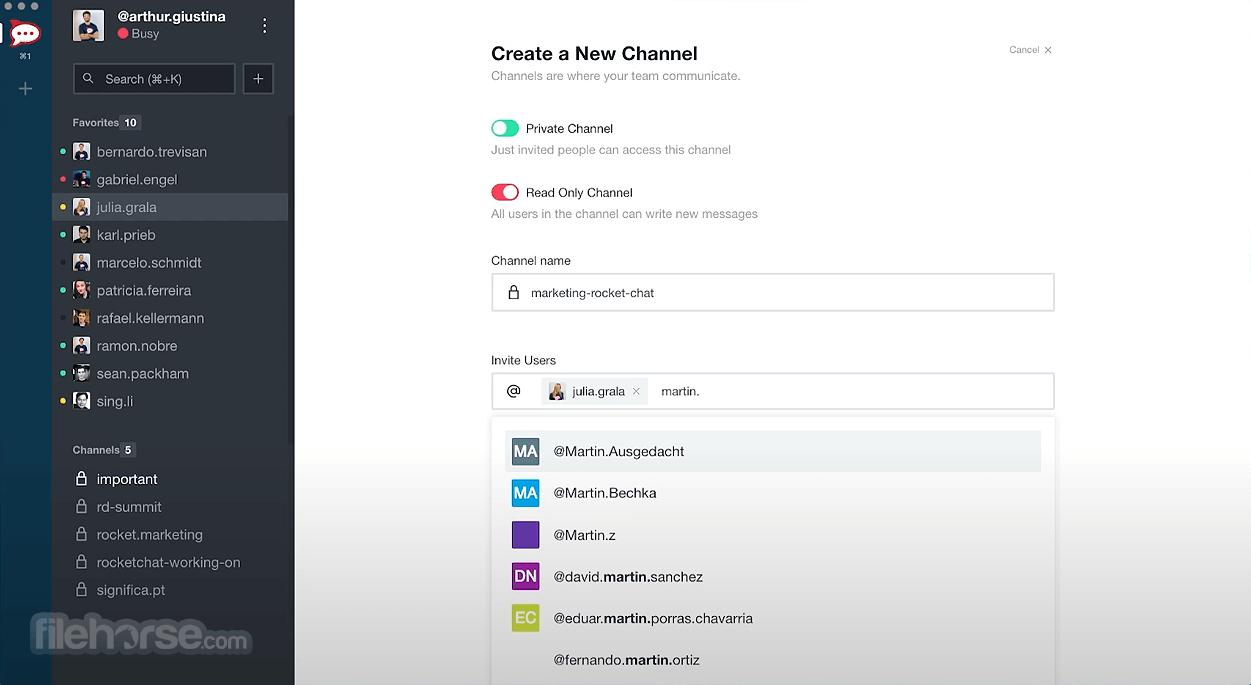
Team messaging and channels
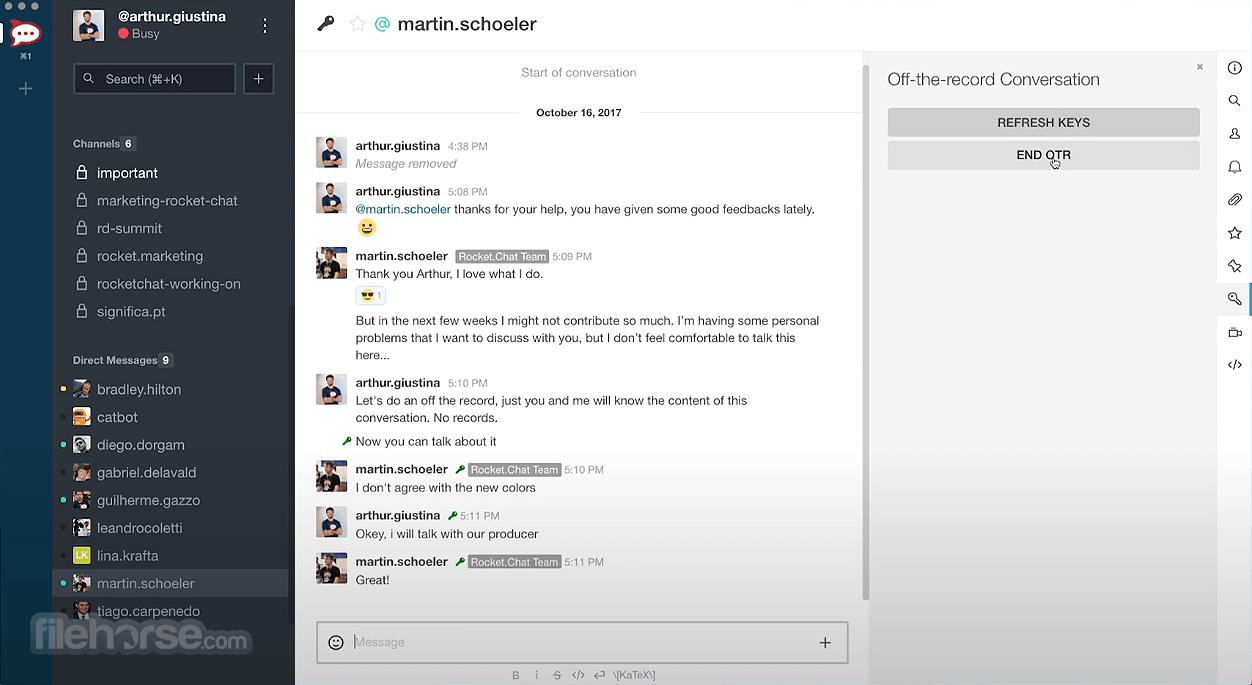
Organized channels for teams, projects, and topics, plus direct messages and group chats, keep communication structured. Threads, mentions, reactions, and powerful search make it easier to follow discussions and retrieve past decisions. -
Voice, video, and screen sharing
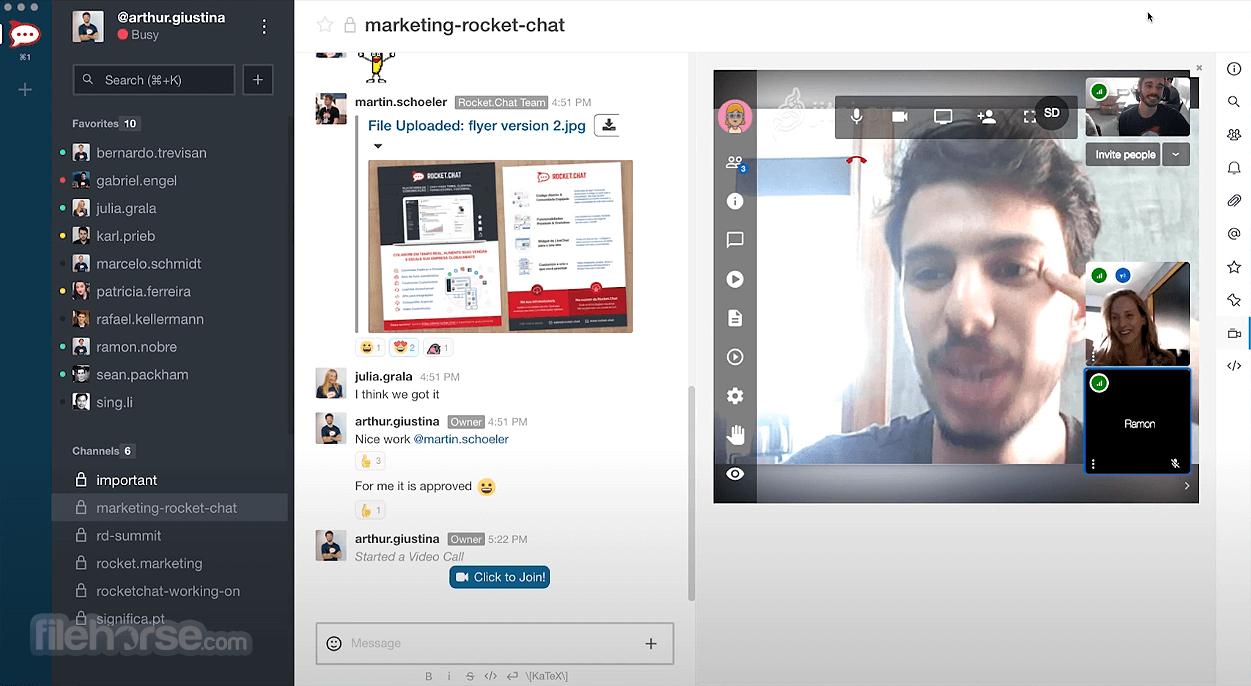
Integrated audio and video calls allow teams to switch from text to real-time conversation when needed. Screen sharing supports demos, incident response, and remote collaboration without leaving the workspace. -
Omnichannel customer engagement
A dedicated Omnichannel module centralizes website live chat, email, and messaging apps such as WhatsApp or SMS into a single agent console. Routing, queues, service hours, and reporting support help desks and contact centers. -
Open source and extensibility
As an open source platform, Rocket.Chat can be customized with integrations, bots, and apps. APIs, webhooks, and marketplace extensions let organizations integrate tools like CRM, monitoring, and DevOps pipelines directly into channels. -
Security and compliance controls
Features such as role-based permissions, two-factor authentication, encryption options, auditing tools, and fine-grained configuration help align the system with internal security standards and external regulations. -
Flexible deployment options
Deployments range from SaaS in Rocket.Chat’s cloud to fully self-managed Kubernetes clusters. This flexibility allows organizations to choose the balance of convenience, control, and compliance they require.
When is Rocket.Chat used in real-world scenarios?
-
Internal collaboration for secure teams
Governments, healthcare providers, and enterprises that handle confidential data use Rocket.Chat as an internal hub where all communication stays under their governance and within trusted infrastructure. -
Customer support and service desks
Support teams combine live chat, email, and messaging channels in the Omnichannel console, route conversations to the right agents, and monitor response times and satisfaction metrics from one place. -
DevOps and incident response
Engineering and operations teams integrate monitoring tools and CI/CD systems so alerts, deployments, and logs appear in dedicated channels, helping teams coordinate responses quickly. -
Remote and distributed workforces
Organizations with staff spread across offices, time zones, or field locations rely on channels, threads, and mobile apps to keep everyone aligned and reduce dependency on meetings or long email chains.
What benefits does Rocket.Chat bring to organizations?
Rocket.Chat offers the advantages of a modern collaboration suite while avoiding strong vendor lock-in. The open source model and self-hosting options give organizations full ownership of their communication data and the ability to adapt the platform to specific compliance or infrastructure requirements.
Consolidating team chat, collaboration, and customer messaging into one system can lower costs compared with maintaining multiple separate tools. It also simplifies onboarding and administration because users and security policies are managed in one environment.
For security-focused organizations, the combination of granular permissions, auditing, encryption options, and isolated deployments reduces risk. For growing teams, the scalability of Rocket.Chat’s architecture supports expansion from small groups to large, multi-site deployments without changing the core collaboration experience.
How does the user experience feel in daily work?
On a daily basis, Rocket.Chat feels familiar to anyone who has used modern chat-based collaboration tools. Users navigate channels for departments and projects, exchange direct messages, share files, and use emojis, reactions, and threads to keep conversations readable. Powerful search helps locate messages, documents, and links across long histories.
Desktop, web, and mobile applications keep messages and notifications synchronized, so conversations can continue smoothly across devices. Users can customize themes, notification preferences, and language settings to match personal work styles.
Administrators and managers work with configuration panels and dashboards to manage users, roles, Omnichannel queues, and integrations without needing to modify the codebase. This balance of usability and control makes Rocket.Chat a practical choice for teams that want secure open source collaboration without sacrificing everyday convenience.
2026-08-31 13:15:04: Kartik Doda at Demo Day 2026 Rocket.Chat Google Summer of Code Youtube
2026-08-31 13:15:03: Opening Welcome at Demo Day 2026 Rocket.Chat Google Summer of Code Youtube
2023-03-13 15:35:12: 🥁 [NEW RELEASE] SIX is out!
With a mission to better serve highly-regulated industries and security-conscious organizations across the globe, we are proud to release our most secure, scalable, sovereign, and seamless version yet.
Learn more 👉 https://t.co/2zkOZKelGR https://t.co/7lJaWyUnIITwitter
2023-02-09 17:00:02: We're at #AFCEAFortBragg! If you're joining the event, come say hello 👋 https://t.co/Np2d08OdIMTwitter
2023-02-07 14:00:01: We're ONE WEEK away from #AFCEAWest in San Diego, California! If you're joining the event, come say hello to our team. 🚀 https://t.co/sblAhN3juTTwitter
2023-02-06 19:08:00: This Thursday and Friday our team will be at #AFCEAFortBragg! If you're joining the event, come say hello. 👋 https://t.co/dbx2T3wzfHTwitter
2023-01-26 14:00:01: We're ONE WEEK away from the The EU Open Source Policy Summit 2023. Will we see you there? 👀
Register and join our CEO's session about Large Scale Public Sector Projects! 👉 https://t.co/ep6PGNJHut https://t.co/UPIaJJ9h7fTwitter
Rocket.Chat Alternatives




Rocket.Chat Reviews & Demos
Rocket.Chat Integrations