Bringg
Languages:
Deutsch
English
Español
Français
Portuguese
Localization:
World

What is Bringg?
Bringg is a delivery management and last-mile orchestration platform for businesses that need better control over complex delivery operations. The service helps companies manage deliveries across internal fleets, third-party carriers, stores, warehouses, distribution centers, and customer-facing channels from one centralized system.
Bringg is mainly designed for retailers, grocery companies, restaurants, logistics providers, healthcare delivery teams, service businesses, and enterprises with high-volume or multi-location delivery needs. Instead of relying on manual dispatching, separate carrier dashboards, spreadsheets, and disconnected tracking tools, Bringg gives teams a structured way to plan, assign, track, optimize, and improve delivery performance.
The platform focuses on the most sensitive part of the customer journey: the last mile. This is where delivery cost, speed, visibility, and customer satisfaction often collide. Bringg helps businesses make delivery operations more predictable, scalable, and measurable while improving the experience for both operations teams and end customers.
What are the key features of Bringg?
-
Delivery Orchestration
Bringg helps businesses coordinate delivery workflows across different fleets, carriers, fulfillment locations, and service models. Orders can be assigned based on availability, geography, delivery promise, cost, capacity, or operational rules. -
Route Planning and Optimization
The platform supports smarter routing for delivery teams, helping reduce unnecessary travel, improve driver productivity, and manage delivery windows more efficiently. -
Fleet and Driver Management
Businesses can manage internal drivers, delivery partners, and outsourced fleets through a single operational layer. This helps dispatchers track performance, monitor active jobs, and respond quickly to delays or exceptions. -
Carrier Network Integration
Bringg allows companies to connect with multiple third-party delivery providers and manage them through one platform. This is useful for businesses that need flexible capacity, same-day delivery, regional coverage, or backup delivery options. -
Real-Time Tracking
The platform provides visibility into delivery progress, driver status, estimated arrival times, and delivery completion. This helps both internal teams and customers stay informed. -
Customer Notifications
Bringg supports customer-facing delivery updates, including tracking pages, delivery alerts, status changes, and estimated arrival information. -
Proof of Delivery
Businesses can capture confirmation that a delivery was completed, including digital signatures, photos, timestamps, or other delivery verification details depending on the workflow. -
Exception Management
Teams can identify and manage delivery issues such as failed deliveries, delays, incorrect addresses, driver problems, or unavailable customers before they turn into larger service problems. -
Analytics and Performance Reporting
Bringg helps businesses analyze delivery performance, cost, carrier reliability, fleet productivity, and customer experience metrics.
How can businesses use Bringg?
-
Retail Delivery Management
Retailers can use Bringg to manage home delivery, same-day delivery, scheduled delivery, store fulfillment, curbside pickup, and returns. -
Grocery and Food Delivery
Grocery and food businesses can use the platform to manage time-sensitive deliveries where route efficiency, accurate ETAs, and customer communication are critical. -
Third-Party Carrier Management
Companies that work with several delivery providers can use Bringg to compare capacity, assign orders, monitor performance, and avoid switching between many carrier systems. -
Enterprise Last-Mile Operations
Large businesses can use Bringg as a central command system for delivery workflows across countries, regions, brands, stores, warehouses, or business units. -
Service and Field Operations
Businesses that send technicians, service teams, or field workers can use Bringg to manage arrival windows, routing, job status, and customer notifications. -
Returns and Reverse Logistics
Bringg can support return flows where pickup scheduling, tracking, proof of collection, and customer communication are important.
What benefits does Bringg provide?
Bringg helps businesses reduce operational chaos in last-mile delivery. It gives teams a clearer view of where orders are, who is responsible for them, what delivery options are available, and which issues require attention.
One major benefit is cost control. By optimizing routing, using the right fleet or carrier for each delivery, and reducing manual work, businesses can improve delivery economics. Another benefit is flexibility. Companies can combine owned fleets, third-party carriers, store-based delivery, and outsourced capacity without losing visibility.
Bringg also improves customer experience. Customers expect clear delivery updates, accurate arrival windows, and fewer surprises. With real-time tracking and automated communication, businesses can reduce customer support pressure and increase trust.
For operations teams, Bringg creates a more structured delivery workflow. Managers can monitor performance, compare delivery providers, handle exceptions, and make decisions based on data rather than guesswork.
What is the user experience like?
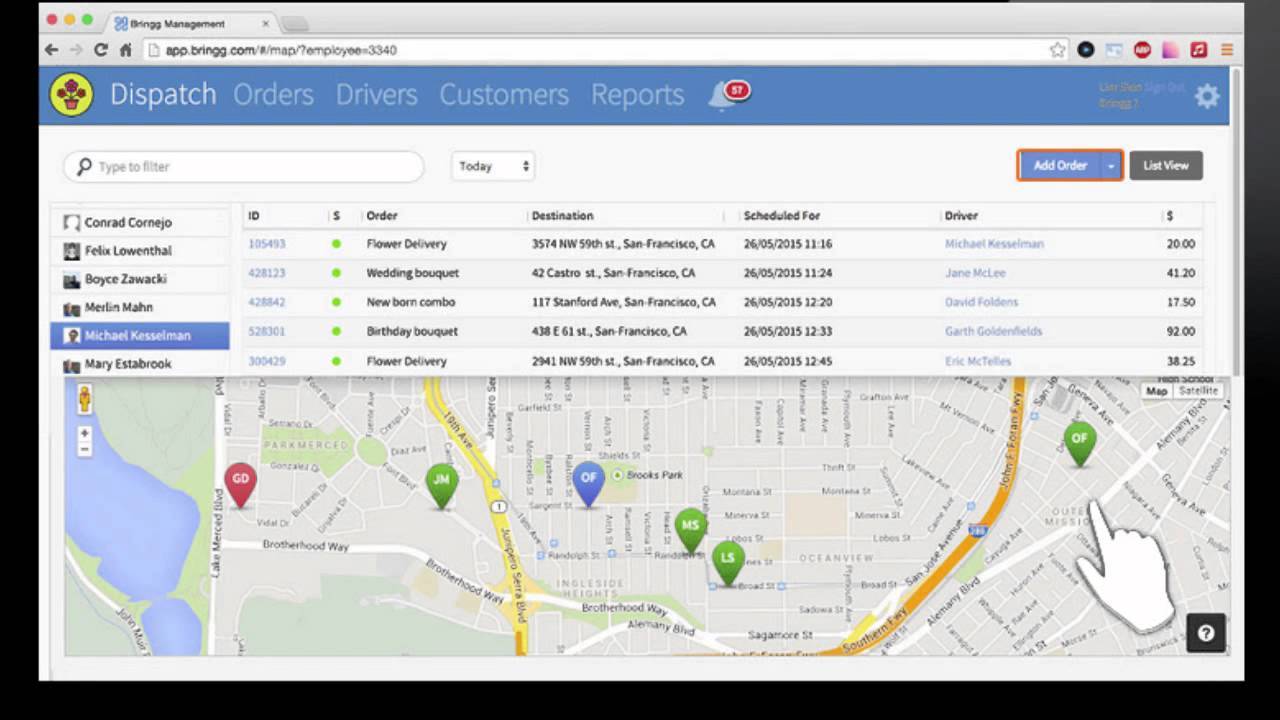
Bringg is built for operational users who need control, visibility, and speed. Dispatchers, logistics managers, store teams, and delivery coordinators can work from dashboards that show active orders, delivery status, routes, drivers, carriers, and exceptions.
The customer-facing experience is focused on clarity. Customers can receive delivery updates, tracking information, estimated arrival times, and confirmation when an order is completed. This reduces uncertainty and helps brands maintain a professional delivery experience even when third-party carriers are involved.
Overall, Bringg feels less like a simple delivery app and more like a logistics control center. It is best suited for businesses where delivery is not a side task, but a core part of revenue, customer satisfaction, and operational performance.
2026-07-09 03:00:23: Four Leaders on Where AI Moves the Needle in Last-Mile Delivery Youtube
2026-06-17 13:30:31: Building Last-Mile Delivery From Scratch: What Actually Matters—with Chris Conway Youtube
2026-05-28 12:00:17: Most LSP Data and Integrations Are Broken. Here’s How to Fix Them—with Jamie Andrade Youtube
2026-05-26 18:20:43: AI in Last-Mile Delivery: What Works and What Doesn't—with Benjamin Gordon Youtube
2026-05-14 12:00:37: Sure! Here’s the translation adapted to English:
**Why Some Last-Mile KPIs Misrepresent Customer Experience—with Paula Natoli** Youtube
2026-04-15 23:04:47: Don’t Give Customers Away. Keep the Delivery Promise—with Chris Rupp Youtube
2026-03-31 03:42:57: How Last-Mile Delivery Impacts High-Value Customer Loyalty—with Ryan Leigh Youtube
2026-03-19 17:13:18: Connect Siloed Systems That Hurt Last-Mile Performance—with Shweta Bhatia Youtube
2026-02-23 20:57:57: Why The Last Mile Will Be Crucial Over The Next Decade—with Ali Kamil Youtube
2026-02-23 20:16:25: Introducing Deliver: The Last-Mile Performance Podcast Youtube
2023-03-28 14:30:02: Will you be at #shoptalk2023 tomorrow?
Then let us know if you would like to learn how to overcome last mile operational challenges and drive ecommerce growth and exceptional customer experiences with fast, cost-effective fulfillment. https://t.co/qN8PdxV7eeTwitter
2023-03-22 17:48:03: Happy Holidays!
May this season bringg you and your families health and happiness. https://t.co/03tftxPQ0uTwitter
2023-03-20 16:40:05: Are you going to #shoptalk2023?
With just ! week to go, we're super excited to connect with the biggest community of retailers + brands.
Let us know if you'd like a meeting with Larry Klein, VP Strategic and Commercial Sales, or Philip Spelman, Director of Strategic Accounts https://t.co/arudqoRUOITwitter
2023-03-15 17:55:04: Are you looking for ways to enhance your #customer experience? Do you want to minimize #WISMO and support calls?
Discover how Fox Racing accomplished these objectives by leveraging Bringg on Salesforce. Check out the success story 👇
https://t.co/dx8g87MJe5Twitter
2023-03-13 17:17:02: In today's fast-paced business environment, it's crucial to maximize the #efficiency of last mile operations. But how do you know which is the best route optimization technology? Read our latest blog 👇 to find out.
https://t.co/hDSNUpqwgmTwitter
2023-03-06 20:04:05: Retailers today face many challenges within the customer journey. Some of the main ones are listed below.
How many of these do you come across? Let us know in the comments below.
#retailers #eCommerce #CustomerSatisfaction
https://t.co/UKisOm2bNV https://t.co/Hdadc1wpb2Twitter
2023-03-03 15:10:04: In today's fast-paced ecommerce environment, it's crucial for retailers to make the returns management process more efficient and cost-effective. Having a DMP in place is a MUST-HAVE for staying ahead of the competition. Check our blog post for more info. https://t.co/mJpuBd4SF3Twitter
2023-03-02 19:50:04: We are super excited to share that we will be attending 'A New Day for Commerce' next week!
This event promises to be a fantastic opportunity to connect with other like-minded professionals to discuss the latest technologies and strategies shaping the future of ecommerce. https://t.co/sENoDyfzZ7Twitter
2023-02-22 14:23:04: Retailers today have many challenges to deal within the customer journey. Here are 8 of the main ones that were concluded in a recent survey. https://t.co/QK5LmEFmgPTwitter
2023-02-21 18:41:03: Drones have the ability to bypass traffic, reach remote locations and have lower costs than car deliveries. However, the technology for drones is still in its infancy and experiencing many challenges.
Do you think drones will start to play a bigger role in deliveries?Twitter
Bringg Alternatives