Chargebee
Languages:
Deutsch
English
Netherlands
Localization:
World

What is Chargebee Subscription Billing Platform?
Chargebee Subscription Billing Platform is designed to handle the recurring revenue operations of modern subscription and usage-based businesses. Instead of hard-coding billing rules in a product or patching together scripts around a payment gateway, companies use Chargebee to centralize plans, pricing, invoicing, taxes, and revenue recognition. The platform connects to payment providers, accounting systems, and CRM tools, so subscription data stays consistent across finance, sales, and support. This makes it easier to run experiments with pricing and packaging, manage free trials and upgrades, and enforce compliant revenue reporting. Chargebee suits SaaS products, membership sites, media subscriptions, e-commerce with subscriptions, and hybrid models that mix one-time purchases with recurring add-ons.
What are the key features of Chargebee?
-
Subscription and billing automation
Chargebee lets teams configure plans, billing cycles, add-ons, coupons, and proration rules, then automatically generates invoices and charges customers on schedule. This removes the need for custom billing logic and supports upgrades, downgrades, pauses, and cancellations without manual intervention. -
Flexible pricing and packaging
The platform supports flat, tiered, volume, and usage-based pricing, as well as free trials and freemium tiers. Product and revenue teams can test new offers, regional price points, and discount structures while keeping the billing engine consistent. -
Payments, dunning, and revenue recovery
Chargebee works with multiple payment gateways and payment methods. It includes dunning workflows to handle failed charges with retries, reminder emails, and rule-based follow-ups aimed at recovering involuntary churn and maximizing collected revenue. -
Taxes and compliance
The system helps calculate and apply taxes based on customer location and product type, and aligns with accounting standards for subscription revenue recognition. This supports more accurate financial statements and reduces manual spreadsheet work. -
Revenue recognition and reporting
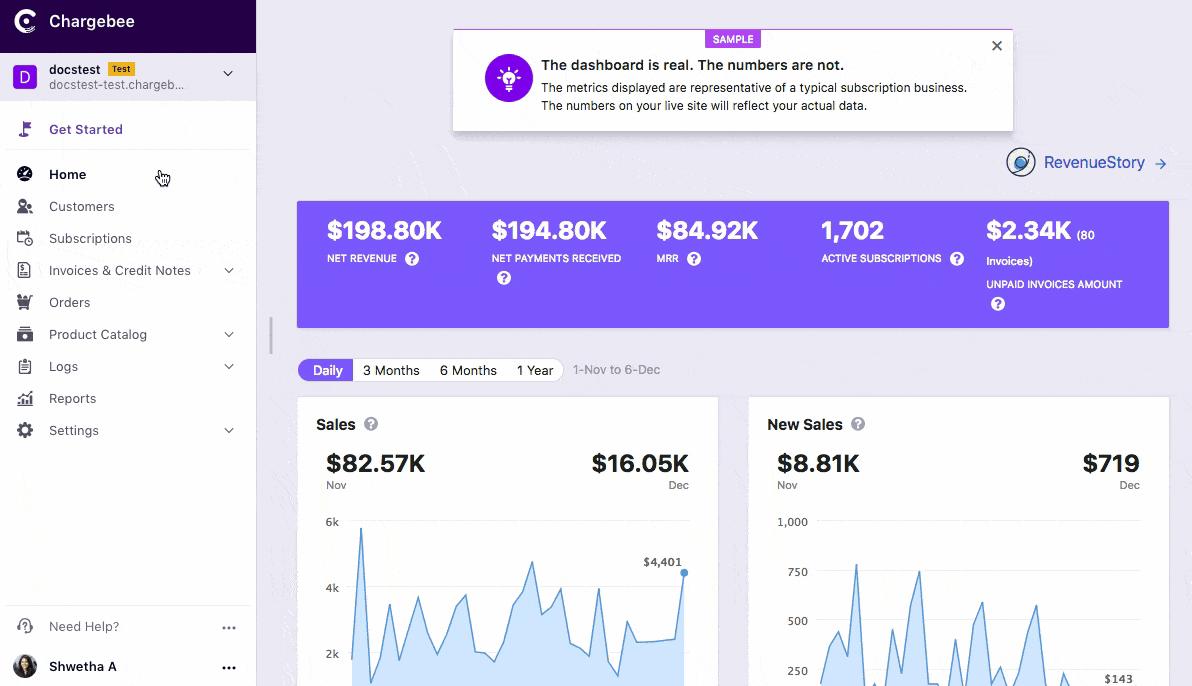
Built-in revenue recognition rules map invoices and contracts to recognition schedules. Dashboards and reports provide visibility into MRR, churn, cohorts, and invoice health, giving finance and RevOps teams a shared view of subscription performance. -
Integrations and APIs
Chargebee offers integrations with accounting, CRM, support, and analytics tools, and exposes APIs and webhooks for custom workflows. This allows subscription data to flow into the broader business stack without duplicated effort.
How is Chargebee used in real businesses?
-
SaaS subscription management
Software companies use Chargebee to handle free trials, onboarding, plan changes, and renewals, while syncing data to CRM and support tools. Sales-led and product-led motions can coexist on the same billing engine. -
High-volume self-serve products
Products with many small customers rely on Chargebee to automate invoicing, dunning, and payment retries at scale. This reduces the cost of servicing low-ticket subscriptions while keeping churn under control. -
Complex B2B deals with contracts
Teams selling annual or multi-year contracts use Chargebee to manage quotes, contracts, staged rollouts, and custom pricing. Invoices and revenue schedules reflect the agreed terms without building one-off logic for each deal. -
Subscription e-commerce and memberships
Online retailers and membership platforms use Chargebee to manage recurring boxes, digital content access, or member-only services. The system keeps billing consistent even as customers change frequency, pause deliveries, or switch tiers. -
Global expansion and multi-currency growth
Businesses expanding into new markets configure multi-currency pricing, localized taxes, and regional gateways in Chargebee. This lets them enter new regions with fewer engineering changes.
What benefits does Chargebee bring to organizations?
Chargebee reduces the engineering burden of billing, so developers can focus on core product features instead of payment edge cases. Revenue and product teams gain the ability to experiment with pricing and packaging quickly, improving monetization and time to market for new offers. Finance teams benefit from consistent, auditable data, automated revenue recognition, and cleaner reporting on key subscription metrics. Centralized dunning and revenue recovery flows help lower involuntary churn and increase net revenue from the existing customer base. Overall, the platform turns billing from a fragile set of scripts into a structured system that supports long-term growth.
What is the user experience with Chargebee?
Day to day, operations, finance, and RevOps teams work primarily inside the Chargebee dashboard to configure plans, tune dunning rules, set tax behavior, and review performance metrics. The interface focuses on mapping real business processes, such as approval flows and trial policies, into reusable configurations rather than one-off fixes. Developers interact through APIs, SDKs, and webhooks, embedding subscription flows into sign-up pages, in-app billing screens, and backend services. Customers experience Chargebee through hosted checkout pages, payment forms, and self-service portals for managing subscriptions, updating payment details, or changing plans. This combination of UI and API control helps organizations keep billing flexible while giving each team the tools needed to manage its part of the revenue lifecycle.
2026-10-09 21:09:04: Product Demo: Quote to Revenue Walkthrough | Chargebee Beelieve '26 | London Youtube
2026-10-09 12:09:33: How Atlassian, Reapit, and Hapana Operationalize AI Pricing | Chargebee Beelieve ‘26 Sydney Youtube
2026-10-09 07:30:45: Building for Millions: Engineering for Monetization at Scale | Chargebee Beelieve '26 Sydney Youtube
2026-10-08 12:14:00: How Xero Is Driving Product-Led Growth in the Age of AI | Chargebee Beelieve '26 Sydney Youtube
2026-08-20 16:11:43: Connect Chargebee MCP to Claude for Billing Intelligence Youtube
2026-08-20 16:11:39: Connect Chargebee MCP to ChatGPT for Billing Intelligence Youtube
2026-08-13 12:43:28: How (Not) to Screw Up Your Pricing Youtube
2026-08-06 13:46:47: 55% of decision makers say AI is increasing their workforce. Youtube
2026-08-06 13:45:05: Monetizing AI is Still Experimental: How to Find the Right Strategy Youtube
2026-08-06 13:39:40: The Double Hockey Stick Problem in AI Pricing Youtube
2023-04-07 16:45:16: Hey #WebDevelopers! Have access to ActiveDEMAND but not sure what it can do? This article is written specifically for website developers/technical people to integrate the many features of ActiveDEMAND when developing #Websites. https://t.co/0VCuvfq5ZNTwitter
2023-04-07 11:47:30: I like easy interfaces doing one-sie two-sie work, but when Im hardcore #Marketing, Im in a 200-row #Excel or #GoogleSheet! Creating a #ContentCalendar or blocking for social posts, Excel is great for bigger #DataProjects. https://t.co/3n4LV0shT7Twitter
2023-04-07 02:48:17: Still building #BuyerJourneys with anecdotal data? Its inexcusable because we have fantastic #UserData we can use to build fantastic journeys. Read on to create meaty, data-driven buyer journeys. https://t.co/9dfhgCo4JxTwitter
2023-04-06 21:47:05: Businesses using #MarketingAutomation say it gets results like higher #ConversionRates (57%), and more and better leads (55%). But for businesses not using it, the lack of expertise and resources to execute are holding them back https://t.co/2YYRAj3PPkTwitter
2023-04-06 16:45:42: Mistakes happen without a system to review work. Eg. an email is sent with the wrong graphics and contact list. Oops! Now with the ActiveDEMAND #ContentApprovalSystem, nothing gets sent out unless it is approved. #ContentModeration https://t.co/fHQc9jPwBPTwitter
2023-04-06 11:45:00: Generate #Leads from an #Unsubscribe page?? Yes, it is possible and we do it. When users click the unsubscribe link, they see a page #personalized to them: with their logo, their name, and their company name. Learn how we do this. https://t.co/qjioPIuRnoTwitter
2023-04-06 02:45:20: System of Record is an IT term describing how data is managed. In the #SalesAndMarketing worlds, the Customer Relationship Management (#CRM) platform is the sales #SystemOfRecord, but what about for #Marketing? https://t.co/G4U4HU6FZQTwitter
2023-04-05 16:45:07: Have you listened to our #MarketingAutomation #Podcast yet? Pitter Patter. Join our VP of Marketing, Adriel and his guests as they discuss all things #marketingautomation. Lots of great info and we hope you will give it a listen. https://t.co/D0NsHUVlnHTwitter
2023-04-05 11:45:05: #MarketingAgencies take any work starting up, but get more selective when they start to scale. Weeding out customers by size, services theyre good at and are profitable. Then, agencies stop and dont take #specialization far enough https://t.co/o7OR5JxlzmTwitter
2023-04-05 02:46:24: Youre building complexity in your #Website to be more personal with your audience. The reason you do it this way? Your website doesnt know whos browsing so it cant show the right content. Why not make your website smarter? #IA https://t.co/hTNgRD5DYgTwitter
Chargebee Alternatives




Chargebee Reviews & Demos
Chargebee Integrations