Agiloft
Customer management
Collaboration and personal effectiveness
Industry products
Help Desk
Electronic document management
Legal Practice Management
Languages:
English
Localization:
World
What is Agiloft and who is it built for?
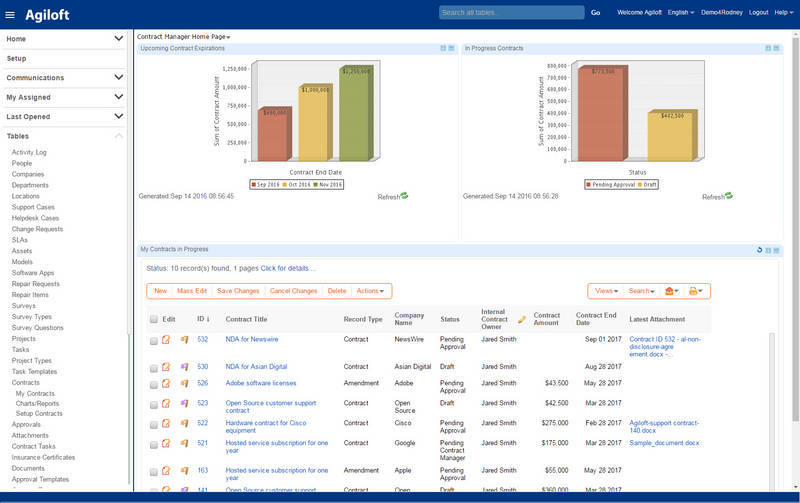
Agiloft is a contract lifecycle management platform built for organizations that want tighter control over contracts, approvals, obligations, and negotiation workflows. Its core pitch is not just document storage, but structured contract operations: turning agreements into searchable data, routing work through configurable processes, and reducing the manual drag that usually sits between legal, procurement, sales, and operations teams. The platform positions itself as a data-first agreement system with AI features, no-code customization, and broad integration support, making it relevant for companies that need more than a static contract repository. Agiloft highlights usage across industries such as technology, healthcare, manufacturing, financial services, pharma, and business services, with role-based relevance especially strong for legal and procurement teams.
What key features does Agiloft offer?
- Contract lifecycle management across the full agreement flow
Agiloft covers contract creation, review, negotiation, approval, execution, obligation tracking, and renewal management. This gives teams one operational layer for the full contract journey instead of scattered files, inbox approvals, and spreadsheet reminders. - No-code workflow customization
One of Agiloft’s strongest positioning points is its no-code interface. Teams can adapt workflows, approval rules, fields, and contract processes without depending heavily on developers. That matters for organizations with unusual internal logic, multi-step approvals, or legal operations teams that want control without opening an engineering ticket every time. - AI-powered contract analysis and extraction
The platform emphasizes AI inside the product for document analysis, extracting key terms, surfacing obligations, and helping organize contract data. This is useful when the real bottleneck is not finding the PDF, but understanding what is buried inside it. - Search, clause, and data visibility tools
Agiloft promotes advanced search and extraction so users can locate clauses, obligations, dates, and critical data points quickly. For companies with hundreds or thousands of agreements, that is the difference between a system of record and a digital attic. - Integration hub with broad system connectivity
Agiloft states that its platform supports drag-and-drop integrations with more than 1,000 business systems. This is important for linking CLM with CRM, procurement, document tools, and enterprise workflows instead of making contract management an isolated island. - Flexible editing experience
Users can work with contracts through the Agiloft viewer as well as Microsoft Word and Google Docs, which reduces resistance from teams that do not want to abandon familiar drafting environments.
Where does Agiloft fit best in real business use?
- Legal operations
Useful for standardizing approvals, reducing manual review overhead, and keeping better visibility across the contract portfolio. - Procurement teams
Strong fit for vendor contracts, obligation tracking, spending visibility, and workflow consistency. - Sales and revenue teams
Helps accelerate agreement turnaround when deal documents need structured approvals and searchable terms. - Complex organizations with many systems
The integration layer makes Agiloft more attractive when contracts must connect to existing CRM, ERP, or procurement tools instead of living in a silo.
What are the main benefits of using Agiloft?
The biggest advantage of Agiloft is flexibility without forcing a deep-code implementation. Many CLM tools promise order, but become rigid the minute a company has unusual approval paths, regional requirements, or industry-specific contract logic. Agiloft leans hard into configurability, which makes it attractive for mature teams that already know their workflow pain points. It also pushes the value of data visibility: contracts become operational assets rather than passive documents. On top of that, the company publicly emphasizes high implementation satisfaction and strong customer retention, which suggests it sells not just software, but a fairly serious services and onboarding motion around it.
What is the user experience like with Agiloft?
Agiloft appears designed for organizations that want power without complete technical dependence. The experience is positioned as user-friendly, configurable, and practical for mixed teams, not only administrators. The no-code model, familiar editing options, and reporting visibility all point toward a platform meant to reduce friction between legal structure and day-to-day business activity. At the same time, this is still enterprise-grade CLM software, so the best fit is not a tiny team looking for a simple signature tool. Agiloft makes more sense where contracts are numerous, process-heavy, and strategically important. In that lane, it looks like a serious operator rather than a shiny demo machine.
2026-10-06 21:53:11: The 5 Stages of CLM Maturity (and How to Move Up) | Procurement Webinar Youtube
2026-10-06 18:59:36: AI and Contracts: Shifting Insight Beyond Legal | Agiloft x SIG Webinar Youtube
2026-09-28 13:34:15: Agiloft CLM Platform Tour Youtube
2026-09-17 15:03:17: America 250: La búsqueda de contratos más inteligentes Youtube
2026-08-03 20:31:28: Agiloft x Lean Solutions Group Customer Story Youtube
2026-08-03 20:26:17: Agiloft x Chemtrec Customer Story Youtube
2026-07-22 14:01:30: Agiloft x Nick Hobson Customer Story Youtube
2026-07-09 19:31:47: Agiloft x FMC Customer Story Youtube
2026-06-09 17:47:19: Agiloft x Aperçu Carré 15 2 Youtube
2026-05-21 14:42:28: Agiloft lleva la contratación al siguiente nivel. Youtube
2023-04-03 22:05:00: Looking to level up your knowledge about the latest trends in sourcing and #procurement?
Tune in this Wednesday April 5 to LinkedIn Live with Agiloft's Prashant Dubey & Dawn Tiura, President & CEO of SIG!
Sign up at the link below and we'll see you there:https://t.co/1MOke6n3kfTwitter
2023-04-02 22:03:01: In the constantly shifting business landscape, CLM solutions enable new agility in the sourcing process.
Is your sourcing team utilizing a CLM system to enhance its success? Check out our white paper "Seven Steps to Success in Sourcing" below: https://t.co/YMepSTkvQg https://t.co/Mujsni9X6rTwitter
2023-04-01 22:08:00: Any decisions over contracts made in today’s uncertain economic landscape could make or break your organization.
Learn everything you need about maximizing your contracts in our blog "Making Better Decisions by Streamlining Your Contract Data" below:
https://t.co/kLoRZunUFN https://t.co/NholTxAs4NTwitter
2023-04-01 01:10:58: We had an amazing time last week at #LegalWeek2023 in NYC. We're still reflecting on all we've learned and the incredible conversations we had with legal pros about the power of #CLM.
What were your favorite moments from Legal Week 2023? Check out some of ours below: https://t.co/y7zQbtErrATwitter
2023-03-30 23:46:27: In a recent episode of the Contract Insights #podinar, Agiloft's Prashant Dubey talks to Donovan Bell, Director of #legalops at Intel, to discuss how Intel has leveraged EQ for business enablement and CLM success.
Watch the full episode below: https://t.co/8Ahe5sfBwd https://t.co/UVkXyj7OqgTwitter
2023-03-28 22:01:00: Developing a contract management plan is a key step in leveling up your contracting.
No matter what industry, the right #CLM solution enhances how the entire enterprise operates.
Check out our blog "5 ways to revolutionize the contracting process" here:https://t.co/LGeFoKoEyH https://t.co/w4tm27twjsTwitter
2023-03-28 01:29:14: Last week, we released episode 2 of our #GenO podinar series!
Here, Agiloft’s Prashant Dubey spoke with Lizzie Shilliam, Chief of Staff of the Office of General Counsel at Vanderbilt University!
Listen to the full episode at the link below 👇
https://t.co/lBIfTZzIsr https://t.co/TW9SheAtYdTwitter
2023-03-25 23:07:35: One of the biggest limitations to King County Health Department's contract management system was its rigidity.
After implementing Agiloft's #CLM, they reduced their costs by 4x.
Read the whole story on King County's experience at the link here: https://t.co/AnmIzgWM2V https://t.co/GQuQB0KxahTwitter
2023-03-24 22:42:55: Recently, Agiloft’s Jim Leason hosted a wine and cheese tasting webinar with Deloitte UK’s Craig Conte where the two discussed the state of Europe’s current #CLM market.
Check out our blog on this webinar titled "The State of CLM in #Europe" below
https://t.co/7qBGisWlov https://t.co/SKeERQ6YfSTwitter
2023-03-23 23:49:55: We love hearing about your success with Agiloft's #CLM 😄
Check out this review on G2 about our customers experience with our CLM.
https://t.co/eNcRUsd5EJ https://t.co/FB9jGASnsFTwitter
Agiloft Alternatives